
What gross profit margin tells you
Gross profit margin is the money left from each sale before the expenses you control, like PPC and refunds. It shows how healthy the margins of all your products are, and lets you compare products across niches.
Most competitors sit within the thresholds below. If you price by your niche's competition, this metric shows whether you're on the high or the low side.
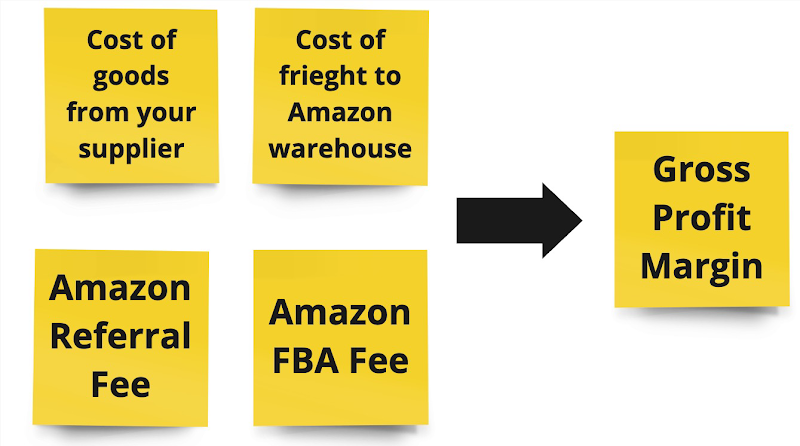
Use the pricing table ↓: one row per product (fill in your landed costs), and a new row for every scenario.
| Situation | Work to do |
|---|---|
| High margin, high price, low CVR | Bring the product to a more competitive price |
| Low margin, competitive price, good CVR | Improve the margin: raise the price or cut backend costs |
The ranges
Based on data from hundreds of brands and thousands of products:
Price, VAT, FBA fee, referral rate, product and freight cost, and an optional coupon to the gross profit margin, its band (36–42% ideal) and what to do.
Want these numbers for your own account? Get a free audit →| Margin | Action |
|---|---|
| Above 45% | Look at the price: you may be overpriced and hurting CVR. Research whether dropping to a 36% margin makes you more competitive. Worth testing: it can raise CVR and CTR, units, organic rank and total profit, and boost the whole flywheel. |
| Below 32% | You're running too thin to make long-term profit. Check whether your price is low for the niche and can rise without hurting sales much. A clearly premium product (main image and title) can raise its price more easily. |
| Below 32% and you can't raise the price | The problem is most likely backend costs: COGS, freight, FBA fees, referral fees, warehouse costs. Or you give more in the offer than needed (e.g. premium packaging you could remove or downgrade). |
- EU/UK marketplaces: calculate everything on the price after VAT.
- Why no refunds? Assume about 2–3%, roughly offset by reimbursements. Not 100% accurate, but a good direction.
- In niches with higher storage fees or refunds, aim for the top of the range: about 38–40% or more.
Testing a lower price
Price is the top of the funnel: the first thing shoppers see in search results. It has a big effect on CTR and CVR, and done well it builds momentum.
Products above a 45% margin should test a lower price, especially if TACOS or ACOS is high or CVR is low. If everything works well at a high margin, there's no need.
| Option | Note |
|---|---|
| Prime Exclusive Discount at the new price | Shows the impact without affecting your deal price |
| Lightning Deal at the new price | The deal badge gives a big boost, so if sales don't rise enough, the price alone probably won't work |
| Lower the price directly | |
| Coupon down to the new price | Not recommended: smaller impact |
Measure: 7 days before vs 7 days after. Units sold, $ profit and % profit (Sellerboard), CTR and CVR (Search Catalog Performance, or top-of-search PPC), organic rank trends across most keywords (Helium 10).
Margin drops from 46% to 36%, but sales rise 50%: a strong win.
TACOS and ACOS fall a lot as CVR and CTR jump, organic rank improves over time, and sales and profit grow further.
- CVR and rank trend up but you make less money? Give it another week to see how you perform once you rank higher.
- Metrics barely move and profit falls? Go back and try another price point.
- The goal: more $ profit, with more organic sales and less reliance on PPC.
Testing a higher price
How high? Research your market and your direct competitors' prices: can you move to the price of a competitor who charges more but still sells many units? Or simply set a price that gives a 35–36% margin.
- Use small increments: about $0.50 more every week.
- Measure with the same metrics as a lower price, and watch for a negative flywheel: falling sales, dropping organic rank, CTR and CVR down a lot.
- A strong drop in sales? Go back and try another method.
When the goal is a higher gross margin, try these first:
| Tactic | Why |
|---|---|
| Raise the price of the non-hero variations | Improves the parent's overall profit, which may be enough, without hurting the listing's rank, CVR or CTR |
| Launch bigger packs as variations | 2-packs, XL, family packs… priced at a normal 36% margin, which raises the listing's average |
| Reduce backend costs | See gross profit margin optimization |
| Test a higher price | As above |
Using the pricing table for marketing
Use the table whenever you plan something new: Lightning Deals and Best Deals, promotions and coupons, price changes, PPC TACOS range changes. Add a line with the new scenario (e.g. the deal price) and read the new margin, then adjust key metrics like TACOS to keep the margin you want.
Found a backend saving (COGS, freight, warehouse cost, referral or FBA fee)? Add a line to see its effect on the margin. Check your gross margin every time you test something new.
Related guides
- Price optimization frameworkFind your niche's pricing sweet spot: when to test, how to research the competitive price, which 2–3 price tests to run, and how to judge…
- Gross profit margin optimizationThe five levers for a better gross margin (COGS, FBA fees, referral fees, refunds and returns, and price), sized by annual impact so you…
- Referral fee optimizationLower the referral fee on every unit: price below a fee threshold, move to a legitimately better-fitting fee category, and use bulk…