
Executive summary
This guide helps Amazon sellers prepare for the shift from keyword-based to AI-driven search, powered by Amazon's COSMO and Rufus systems. It explains how to structure listings, content and PPC campaigns to align with how Amazon's AI now interprets intent and customer needs, and includes a full example listing and checklist.
For years, sellers relied on keyword stuffing, feature lists and backend hacks to rank and convert. With COSMO and Rufus, Amazon's AI-driven systems are rewriting the playbook: they change the way customers shop, and sellers must evolve their content strategy to stay ahead. The two terms are often used interchangeably, but they serve distinct roles.
COSMO and Rufus
COSMO = the brain (back-end AI engine). Amazon's proprietary AI model powering many aspects of personalization and search. It isn't customer-facing: it's the decision-making engine that drives how and why products are prioritized, recommended or surfaced. COSMO analyzes:
- Your past purchases
- Browsing behavior
- Ignored product types
- Preferred attributes (e.g. vegan, BPA-free, organic)
In essence, COSMO replaces the rule-based personalization of the past ("People who viewed this also viewed…") with intent-based prediction and content filtering, like a smart assistant that only shows you what you probably want.
Rufus = the guide (customer-facing interface). The conversational AI built into Amazon's app and site, acting as a product discovery assistant. Launched in 2023, it helps shoppers with natural-language questions like "Best sunscreen for sensitive skin?" or "Which air purifier is best for pets?". Rufus pulls its answers from COSMO's back-end intelligence and from live product detail pages, reviews, A+ content and Storefronts.
| Layer | COSMO | Rufus |
|---|---|---|
| Role | Core AI decision engine | Conversational shopping assistant |
| Visibility | Hidden (no logo or UI) | Shopper-facing (chat interface) |
| Focus | Understands behavior, filters results | Responds to prompts, explains choices |
| Optimization focus | Engagement signals, product content, user behavior | FAQs, natural-language bullets, content clarity |
Why sellers should care: from keyword matching to intent matching
Amazon has moved from matching on keywords and search volume alone to matching customer intent.
| Old SEO (A9/A10 days) | New AI optimization |
|---|---|
| Identify high-volume keywords | Match search intent, not just keywords |
| Insert them in titles, bullets, backend fields | Use natural language, questions and use-case phrasing |
| Hope for impressions and clicks | Provide context through content, not just word matches |
Until recently, listings were keyword-heavy, and the algorithm ranked on search volume plus relevance and indexing. The AI now also looks at the shopper's intent, which is often about benefits or use rather than features.
"500mg of turmeric" = old model: title and bullets built on features or high-volume keywords.
"Supports joint comfort after long walks" = AI-ready: shoppers ask Rufus how a product will help them, so FAQs and descriptions that answer with benefits are now more useful.
How to run a prompt-based Rufus test
A prompt-based Rufus test checks manually whether Amazon's AI picks up your product for shopper-style questions: you type natural-language prompts and look for whether Rufus includes your ASIN in its recommendations.
| Stage | What to test | Why it's useful |
|---|---|---|
| Before optimization | Type 3–5 relevant prompts and record whether your product appears | Establish a baseline for current AI visibility |
| 2–4 weeks after updates | Repeat the same prompts | See if updated content improved discoverability |
| Every 1–2 months | Add new prompts from reviews, search terms, FAQs | Spot long-term trends and opportunities |
Example: if you sell collagen, test prompts like "best collagen for women over 50" or "can I mix collagen in coffee?". Look for your product in the Rufus chat answers, the "Products you may like" AI tiles, and the suggested product grids below the AI box.
| Prompt | My ASIN shown? | Position | Notes |
|---|---|---|---|
| Best collagen for women 50+ | ✅ | 2nd tile | Likely due to benefit overlay in image |
| Collagen for joint pain | ❌ | — | Add clearer language in bullets |
Log every test in the Rufus tracking sheet ↓: date, ASIN, product, prompt, shown (Y/N), position, where it showed and the action you took. The Summary tab shows each prompt's shown rate and whether it showed on the last test.
Where to find Rufus and what to look at
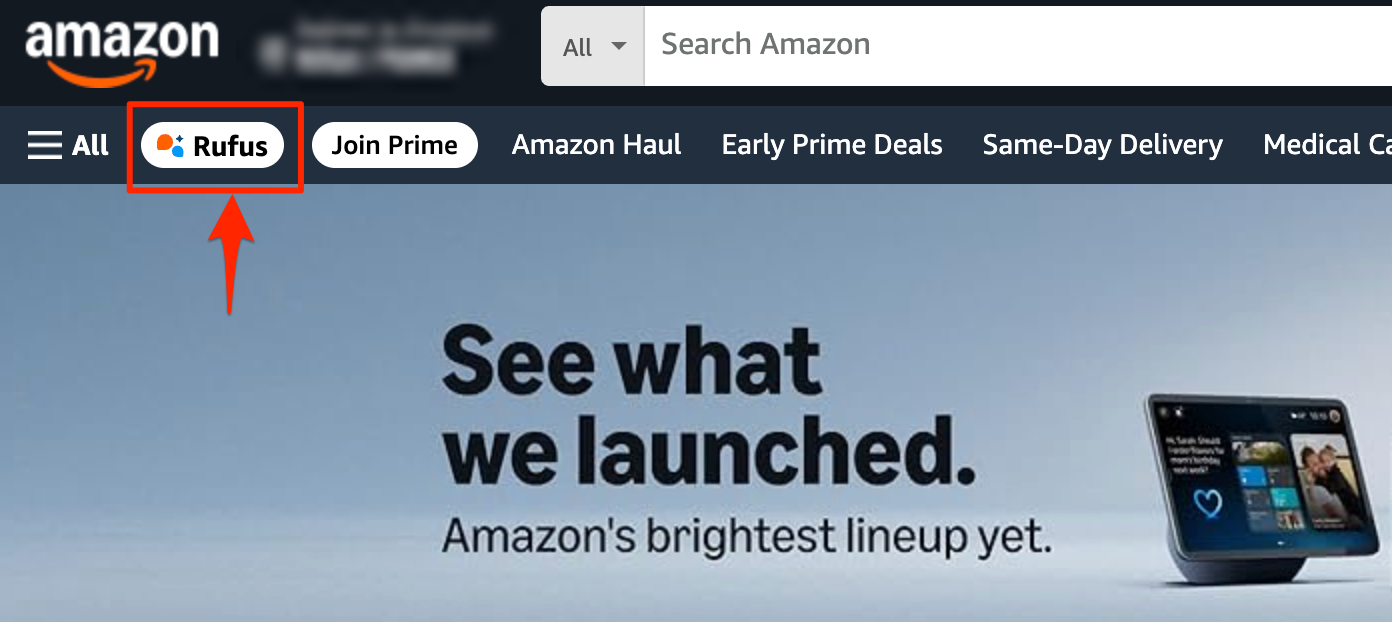
- Open Rufus
Rufus is at the top left of the main page: click the Rufus icon.
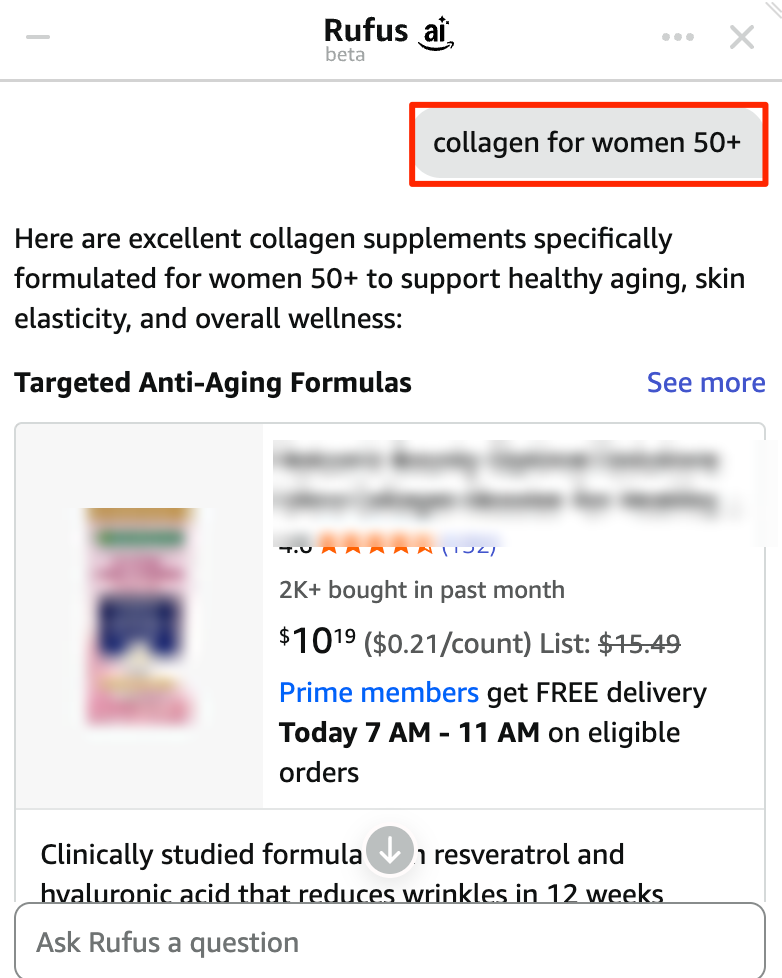
- Ask a question for your product
A search box pops up. Enter a query related to your product; the results show products specific to the query.
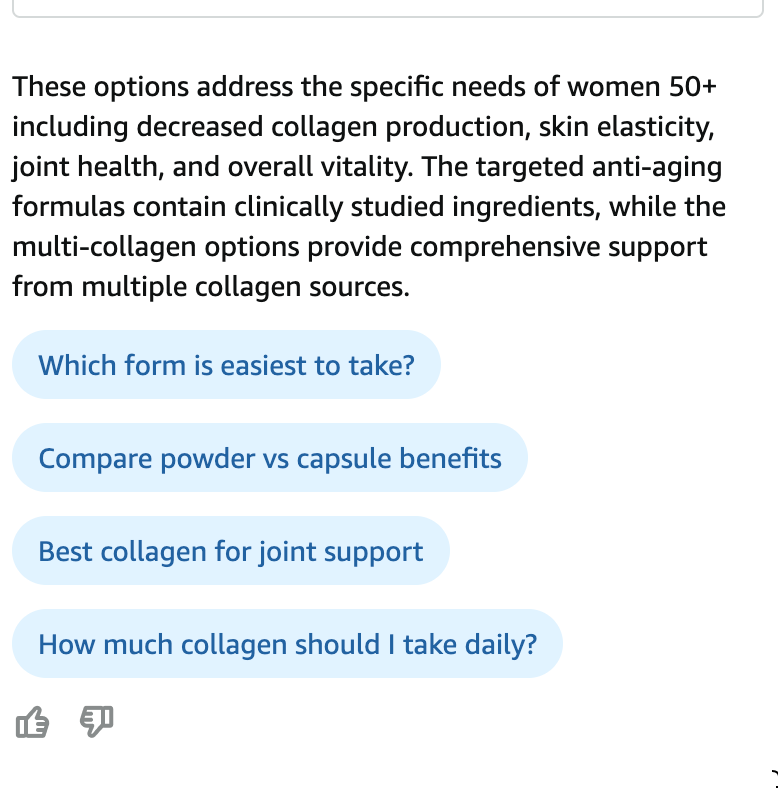
- Note the follow-up questions
Under the products, Rufus shows questions customers ask about this kind of product. Consider answering them on your listing (check relevance: not all of them will fit your product).
- Check the questions on your own product page
Your detail page shows an Ask Rufus box with the questions Amazon's AI thinks are relevant to your product. Make sure every one of them is answered on the listing.
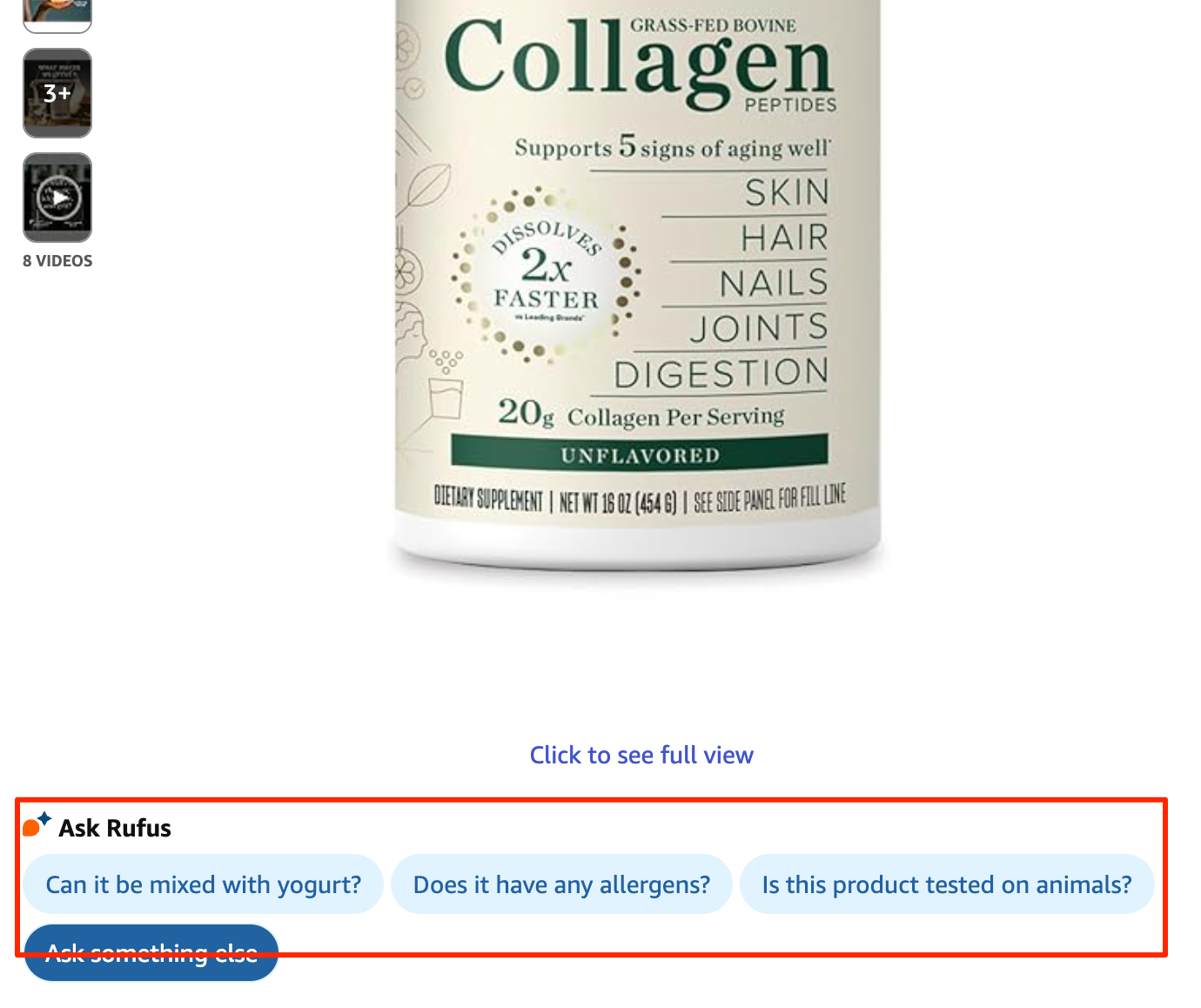
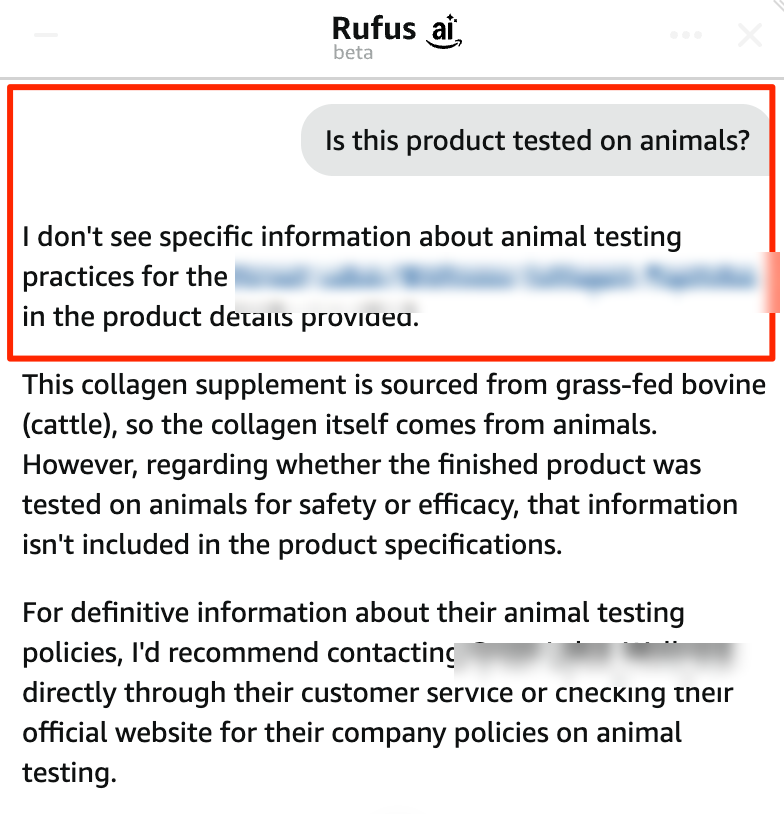
In this example the brand hasn't used the AI prompts to its advantage: clicking the animal-testing question shows the listing has no information about it, a missed opportunity if these questions lead to orders.
Listing optimization strategy: AI edition
To align with how COSMO and Rufus understand, rank and recommend products, your listing needs to go beyond keywords and focus on structure, clarity and shopper relevance.
| Section | Optimization strategy |
|---|---|
| Title | Combine the core product name with a clear use-case or customer benefit: "Compression Socks for Travel & Recovery" instead of just "Compression Socks". Add short natural phrasing + use-case, e.g. "Vegan Gummies for Bloating Relief & Gut Health". |
| Bullets | Use a 3:2 format: three bullets for product features/benefits, two that speak directly to the customer's use-case, scenario or lifestyle. |
| Description / long copy | Present content as question-and-answer blocks or mini-guides, with natural phrasing that mirrors what a shopper would ask (e.g. "Is this safe for kids?"). |
| A+ content | Add structured modules that mirror real-world questions: comparison charts, usage scenarios, trust signals (certifications, guarantees) and visual storytelling. |
| Images & infographics | Overlay short, benefit-driven phrases ("Leak-proof lid", "Easy-grip for arthritis") on the images to give Rufus context. Add relevant keywords as alt text in the file (if your designer uses Photoshop, give them the keyword list) and use a keyword-rich file name, e.g. best collagen for women over 50.jpg. |
| Video | Demo videos showing the product in use, with voiceovers or captions that reinforce use-case language and common shopper concerns. |
| Backend attributes | Fill every applicable field with accurate, specific data: intended use, user type, materials, certifications, compatibility. These structured fields are crucial to COSMO's understanding. |
| Customer questions & reviews | Answer shopper questions with clear, helpful answers in a friendly, readable tone. Reviews that mention lifestyle fit or personal context ("Great for my elderly mom") are highly valuable. |
Advertising optimization for Rufus and COSMO
| Area | What to do |
|---|---|
| Intent-based PPC | Build campaigns around prompt-style keywords (e.g. "best office chair for back pain"); align targeting with FAQ-style phrases. |
| Message matching | Ad copy must mirror the listing. Avoid any mismatch between the ad's promise and the product page: it hurts CVR and AI trust. |
| Prompt-based testing | Search natural prompts before and after optimization (e.g. "best collagen for women over 50") and check manually whether your ASIN appears in Rufus suggestions. |
| Metric | Why it matters |
|---|---|
| CVR (conversion rate) | AI-optimized content = more aligned shoppers = better conversions |
| BSR (Best Seller Rank) | Higher conversions lift organic rank, especially in AI results |
| SQP (Search Query Performance) | Your share of impressions, clicks and purchases for each search query in Brand Analytics: shows whether clearer content wins more of the queries you target. See SQP data explained. |
| Share of voice | Track whether you appear in Rufus AI placements for key prompts |
Patience required: AI needs time
COSMO and Rufus don't react instantly. Listing changes can take 4–12 weeks to be interpreted, re-crawled and surfaced, and some signals take longer, especially when metadata or visual content is involved.
| Week | Task |
|---|---|
| Week 0 | Finalize listing and A+ updates; align PPC with use-case messaging |
| Week 2 | Begin monitoring CTR, CVR and SQP in the Ads console + Brand Analytics |
| Week 4 | Run your first prompt-based test in Rufus and log your ASIN visibility |
| Week 8 | Check whether share of voice or BSR has improved; test new prompts |
| Week 12 | Review full performance, update content if needed, and retest |
Checklist for intent-based optimization
- Natural phrases used in the product title and bullets (no keyword stuffing)
- Listing includes conversational Q&A-style content (in bullets or A+)
- Lifestyle images have benefit-driven text overlays
- Backend attributes fully completed with specific structured data
- Ad copy matches the listing's tone and product promise
- Prompt-based search tests performed in Rufus (before/after visibility)
- Performance monitored regularly via CTR, CVR, SQP and share of voice
Sample AI-optimized listing: collagen powder for women 50+
This sample shows how to structure a listing and campaigns around COSMO/Rufus priorities.
"Hydrolyzed Collagen Peptides for Women 50+ – Joint, Skin & Bone Support – Unflavored, 30 Servings"
Combines product name + use-case + target audience + benefit.
Supports Skin Elasticity & Joint Comfort – Formulated to help reduce visible signs of aging and ease stiffness
High-Absorption Peptides – Enzymatically hydrolyzed for superior bioavailability
Unflavored & Mixes Easily – Perfect in smoothies, coffee, or oatmeal
Tailored for Women Over 50 – Supports hormonal balance and bone density as you age
Ideal for Daily Wellness Routines – Designed for busy women prioritizing health
Mirrors common prompt language.
| Asset | Plan |
|---|---|
| Main image | Clean pouch + scoop on a white background |
| Lifestyle image 1 | Older woman adding powder to a smoothie, overlay: "Daily Support for Joints, Skin & Energy" |
| Infographic | "Why Collagen After 50?": declining natural production, benefits by decade |
| Video | Short explainer "What to expect when taking collagen daily", with captions like "Notice smoother skin in 4–6 weeks" |
| A+ content | Headings "How to Use It", "Why Collagen After 50?", "Our Sourcing Promise"; a comparison chart vs marine collagen or gummies; an FAQ module: "Can I take this with calcium?" / "How long until I see results?" |
| Backend attributes | Intended use: skin support, bone health, anti-aging · Target demographic: women over 50 · Ingredient type: bovine peptides, hydrolyzed · Format: powder, unflavored, 30 servings |
| Campaign type | Example keyword themes | Notes |
|---|---|---|
| Sponsored Brands video | "Collagen for women over 50" | Matches common Rufus prompts; video performs well with intent queries |
| Sponsored Products auto | Let COSMO test new long-tail prompts | Monitor reports for emerging natural-language queries |
| Sponsored Display | Retarget visitors who didn't purchase | Re-engage with testimonials or use-case overlay images |
Every PPC theme ties back to the structure of the listing: AI consistency improves conversion and discoverability.
Action steps
AI is no longer a future trend: it's live, influencing what customers see and buy every day. The sellers who adapt will win the next wave of organic visibility, conversions and category dominance.
- Update listing titles
Add a clear use-case or customer benefit (not just features).
- Rewrite bullets
Use natural, conversational phrasing that answers real shopper questions.
- Update images
Include short, benefit-driven text overlays.
- Fill backend attributes
Complete every relevant field (use, audience, material, etc.).
- Run a Rufus prompt test
Search 3–5 natural questions and see whether your ASIN appears; log it in the tracking sheet ↓.
- Align PPC keywords
Use intent-style phrases like "best for…" or "helps with…".
- Track impact
Recheck visibility, CTR and conversions after 4–8 weeks.
Related guides
- Alexa for Shopping and Amazon ads: making products worth recommendingWhat changed in 2026 (Sponsored Products and Brands prompts, Rufus becoming Alexa for Shopping, Amazon Ads Agent), why a product now has…
- Amazon SEO: optimizing your listingResearch keywords, put the top ones in the title, fill the backend search terms with everything else, upload, and check that Amazon…
- Using DataDive for SEOBuild a niche from 20 close competitors in DataDive, clean the master keyword list, and write a title, bullets and search terms that reach…
- How to use SQP: shares, opportunities and shopping conceptsRead Search Query Performance as your share of the market at each funnel step, spot the four patterns (including queries where you convert…
- Search Query Performance: how Amazon computes the dataWhy SQP purchases never match Business Reports: SQP counts only clicks from page 1 of search results (organic and some ads), purchases…
- A+ content with all your other productsAdd a comparison chart module to your A+ content that shows and links up to six of your products, so shoppers find your range instead of a…