
Why compare
Compare your products against each other to find the one with the greatest potential, so you know where to put your attention, time and resources. The comparison is about the offer, reviews and market position: the stronger your offer versus direct competitors, the more likely a relaunch succeeds.
| Part | What |
|---|---|
| Price / value for money | Your price against what you provide |
| Main image | Quality and appeal |
| Number of reviews | How many reviews you have |
| Rating | Your overall rating |
The stronger you are on these against direct competitors, the more shoppers pick you, and the easier it is to reach and hold a high rank.
Fill in the table
- Download the table
Product comparison table ↓: one tab per product (rename it to the product's main keyword) and a Total comparison tab.
- Pick the candidates
Higher sales, more reviews, and higher margins (at least 33% gross margin before PPC). e.g. the 4 products with the highest net margin last month, or 4 products with 300+ reviews.
- List 7–10 direct competitors
As similar to your product as possible.
- Value for money
Price, number of units or size, and price per unit. e.g. a 4-pack for $10 is $2.50 a unit; a 5-pack for $11 is better value at $2.20.
- Reviews and rating
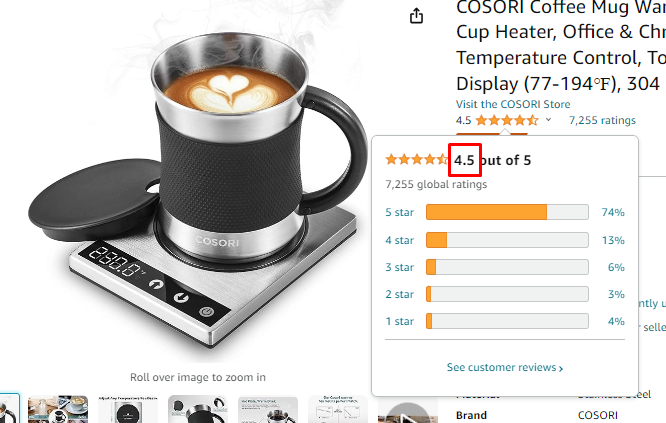
Each competitor's review count and star rating (e.g. 4.5 vs 4).
- Sales in the last 30 days
From Jungle Scout or Helium 10, for each competitor and for you: your position among the top 10, and how much room you have to grow.
- Search volume growth (90 days)
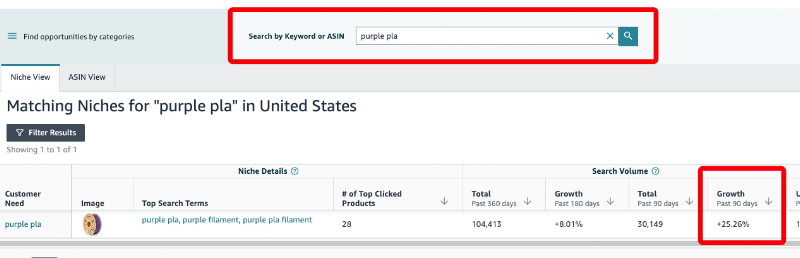
Growth → Product Opportunity Explorer → search the main keyword → choose your niche → copy the search volume growth %.
- Answer the comparison questions
The ranks for offer, reviews and sales fill in automatically; check them against the questions, and add your gross margin and inventory (FBA + 3PL units).
- Repeat for every candidate
The Total comparison tab collects them all.
Choose the products
| Criterion | Better is |
|---|---|
| Price / value for money (rank) | Lower: the best offer against competitors |
| Reviews (rank) | Lower: the most reviews against competitors |
| Sales you can grow to | Higher: the biggest potential in the niche |
| Rating | Higher = best, Normal = good, Lower = bad (avoid) |
| Search volume growth | Higher |
| Gross profit margin % | Higher |
- Mark the winner of each criterion in green (best offer, most reviews, highest margin…), then pick the 1–2 products with the best starting point.
- Most important: the offer and the gross margin. Very high margin but a weak offer? Consider adjusting the price for a better offer while keeping a healthy 33–42%.
- Being in the top 3 for reviews raises the chance of success a lot.
- Big search volume growth signals strong potential; bigger growth potential = bigger upside.
- Avoid products with a Lower rating: they're unlikely to succeed.
Related guides
- Sleeping product launchFor products with too little SQP and PPC data to plan a relaunch: research keywords from competitors, group them, and buy 50–100…
- The relaunch playbook: growing organic rankWhy organic rank drives profit, what Amazon rewards (CVR, sales velocity, CTR), the five-step data-driven relaunch, what it costs, why one…
- New products: pricing for conversionA new product with few reviews converts poorly and PPC runs at a high ACOS. If that's you, find the price that makes you the best deal in…