
Before you start
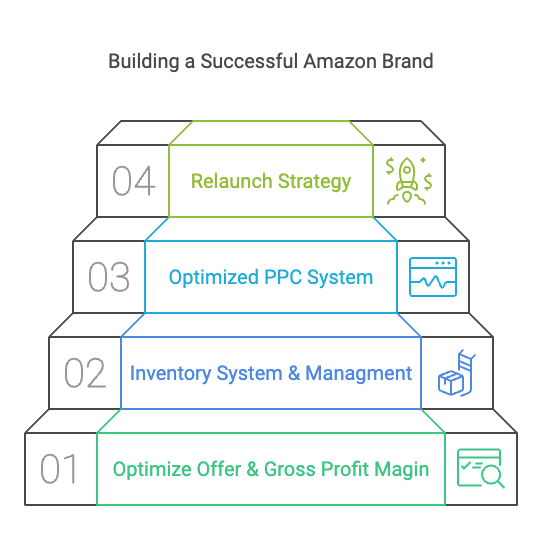
Start a relaunch only when the first three pillars of a successful brand are in place:
- Your offer, product and gross margin are as good as they can be
- Inventory management is strong: 98%+ in stock
- Your PPC system is optimized weekly and helps products grow instead of holding them back
If they aren't ready, fix them first: it will make you more money than a relaunch, because they're the foundation. Then relaunching is the next step: improving organic rank for as many keywords as possible, the second part of the PPC system.
Why organic rank matters
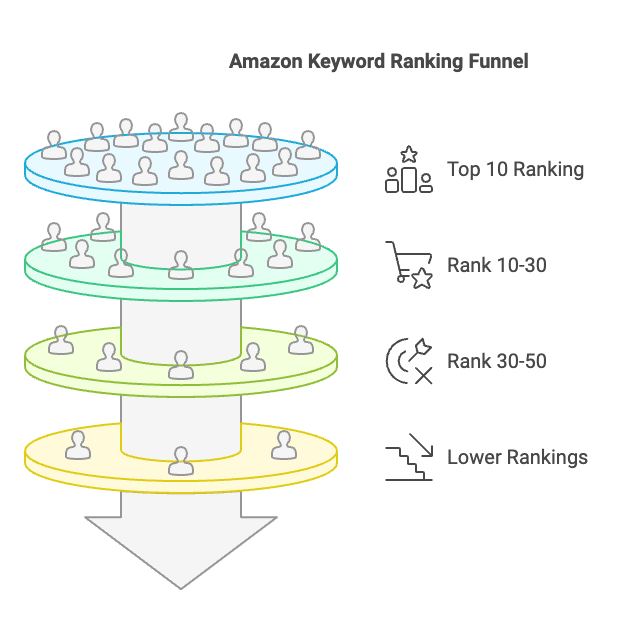
Think of Amazon as the world's biggest mall, and each keyword as a mall of its own (some bigger than any mall you know). Your organic rank is where your store is in it.
| Rank | In the mall |
|---|---|
| Top 10 | At the entrance: lots of impressions, clicks and sales |
| 10–30 | After the main stores: not the worst spot, but room to improve |
| Page 2 (30–50) | In a back corner: few impressions and sales |
| Lower | In the parking lot: nobody sees you |
Organic sales are free, and they drive most of your profit: the more you generate, the more you make. Unlike a mall, where the richest stores buy the best spots for years, on Amazon customers decide who ranks: Amazon tracks which listings they click, add to cart and buy, and which sell the most.
| KPI | Meaning |
|---|---|
| Conversion rate (CVR) | Of everyone who searched a keyword and clicked your product, how many bought (orders ÷ clicks) |
| Sales velocity | Of all purchases after a keyword search, how many were yours, and do you sell more or fewer units than competitors overall? |
| Click-through rate (CTR) | Of everyone who searched the keyword, how many clicked your product (clicks ÷ impressions) |
The process in short
The process is completely data-driven: if the data looks good, keep going; if not, fix the problem or move to other keywords. Each stage has data points that give a green light. Follow the steps exactly, and don't skip any.
| Step | What happens | Guide |
|---|---|---|
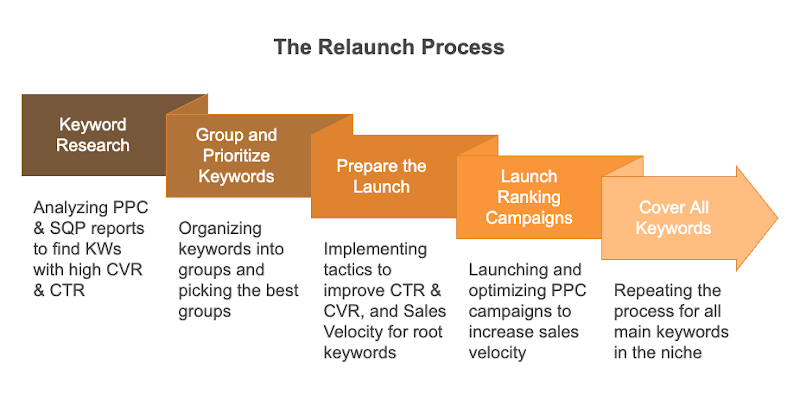
| 1. Keyword research sheet | Find keywords where your CVR and/or CTR beat the keyword average, from SQP and the search term report. High CVR and CTR mean that if you win on velocity, you'll climb. | SQP keyword sheet |
| 2. Group and prioritize | Build keyword groups (a root keyword + its long tails) and start with the group most likely to rank. | Keyword groups |
| 3. Prepare and kick off | Lift CTR and CVR for the root keyword: keyword in the main image, at the start of the title, coupons, deals and more. Then launch the root and long-tail campaigns. | Prepare & kick off |
| 4. Optimize the campaigns | Stabilize, scale to 30–35% then 50–55% top-of-search impression share, then scale back once you rank. | Optimize & monitor · Track results |
| 5. Cover all keywords | Move the freed budget to the next group and repeat until you've covered the niche's main keywords. |
| Type | For | How |
|---|---|---|
| Successful product launch | Products with plenty of PPC and SQP data | Use the data to move fast through the steps |
| Sleeping product launch | Products with little or no SQP or PPC data | Buy the missing data first, then follow the same steps: sleeping product launch |
Expectations and cost
Organic rank is the holy grail of brand profit, but if your product isn't "worthy" of the top, it won't get there until you make it worthy. Look at the top 5 in your niche: if you offer exactly what they do at 3× the price, shoppers won't choose you. The process shows whether your product is worthy for certain keywords, and you don't push until the data looks good. Then you use every tactic to make it even more worthy, and push.
| Question | Answer |
|---|---|
| How many products? | Start with your top 1–2 products, one keyword group each. Relaunching is expensive: high risk, high reward. |
| Why only 1 (max 2) keyword groups? | To rank you must win on sales velocity: be one of the products driving the most sales on the keyword. That costs more than expected, so keep the whole budget on one group per product instead of splitting a small budget across many keywords. |
| What happens after? | Once you rank, organic sales support the sponsored ones and free the PPC budget for the next group. Unsure about the upfront spend? Start slower, look for early signs, then decide. |
What it costs: take the top-of-search CPC from your campaigns and the root keyword's SFR from Brand Analytics for a first estimate. Once you have data, like your search term impression share, use the second estimate. Both are in the relaunch cost calculator ↓.
Root keyword SFR and top-of-search CPC to a quick monthly estimate, then current clicks, impression share and CPC to the daily and monthly cost at 35% or 50% impression share and the margin after PPC.
Want these numbers for your own account? Get a free audit →The long-term plan
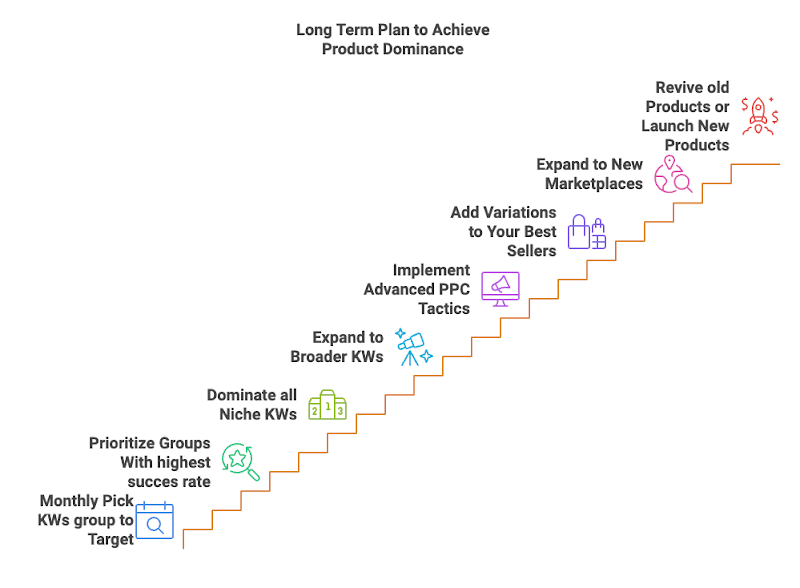
- Plan your month: decide which product to push and for which keyword group. Focus on successful products with good momentum first; only then the sleeping ones.
- Start with the groups most likely to win, then take more risk.
- Dominate your niche in every marketplace: rank at the top for all the niche's root keywords everywhere you sell, then expand to broader discovery keywords.
| Lever | How |
|---|---|
| Category keywords | Dominate "standing desk"? Go after "office desk" |
| Advanced PPC | Full coverage with other ad types (SBV, SB), and scale profit campaigns |
| New variations | Target keywords the hero ASIN can't rank for, and raise AOV and CVR: can be a game changer |
| New marketplaces | New audiences for the same product |
| Revive or launch products | Once the main product is maximized, bring back dead products or launch new ones |
Related guides
- Relaunch checklistEvery task of a relaunch in order: for successful products (SQP analysis, groups, listing prep, campaigns, monitoring), for sleeping…
- Sleeping product launchFor products with too little SQP and PPC data to plan a relaunch: research keywords from competitors, group them, and buy 50–100…
- Product comparison table: which product to relaunchCompare each candidate product with its 7–10 direct competitors on value for money, reviews, rating, sales, search volume growth and…
- Keyword research for a relaunch with Brand AnalyticsRelaunch step 1: pull 90% of your niche's keywords from 5–10 competitors in Brand Analytics, add SQP, PPC and organic rank data, and mark…
- Prepare and kick off a launchRelaunch step 4: lift CTR and CVR for the root keyword (title, coupon, deals, main image, strike-through price, images 2–3), then launch a…