
Before you start
No product is guaranteed to win, but assessing many ideas, vetting them thoroughly and following a data-driven system massively raises your chances. Five steps take a long list of ideas down to a short list of the best 3, all based on Amazon data.

150 ideas in 4 weeks → 2 new brands.
One was a complete failure; the other grew to $5M in revenue at a 25% margin and sold at a 6× multiple.
| Tool | Use |
|---|---|
| Helium 10 Chrome extension (X-ray) | Export a search's market data from Amazon |
| Helium 10 Black Box | Find more product opportunities |
| The R&D workbook | Score and compare every opportunity: product R&D workbook ↓ |
What a good market looks like
A market has potential when you can realistically compete with the existing listings. Usually that means listings making good revenue with few reviews: the market is accessible to new listings, which launch with few reviews. Those listings could be you in 3 months.
| Good market | Bad market |
|---|---|
| Several listings making $50K+ a month with under 200 reviews | Most revenue in one or two listings |
| Average reviews under 500 for all listings making $25K+ | High review counts (5,000+) across several listings |
| Few Chinese or Amazon listings (FBA or FBM) | Strong brand-name listings |
| You can offer a competitive deal at high margins (40%+) | Many Chinese or Amazon listings |
| Repeat purchase (Subscribe & Save) products |
Phase 1: set up the scoring sheet
The product R&D workbook ↓ scores each market on size, competitor strength, review counts of the leaders, how hard the category is to enter and more, for an overall score out of 100 you can compare across ideas.
- Search the niche's main keyword on Amazon
e.g. "yoga mat".
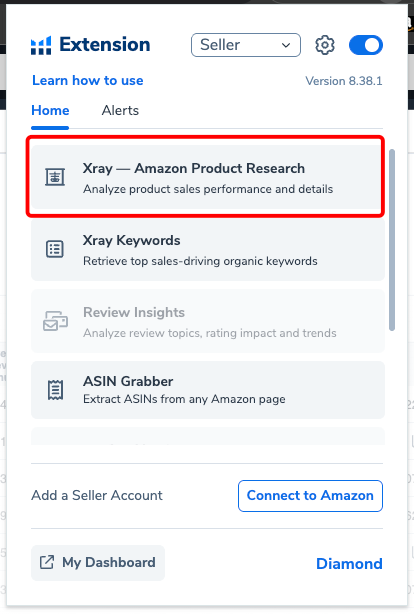
- Run the Helium 10 extension's X-ray
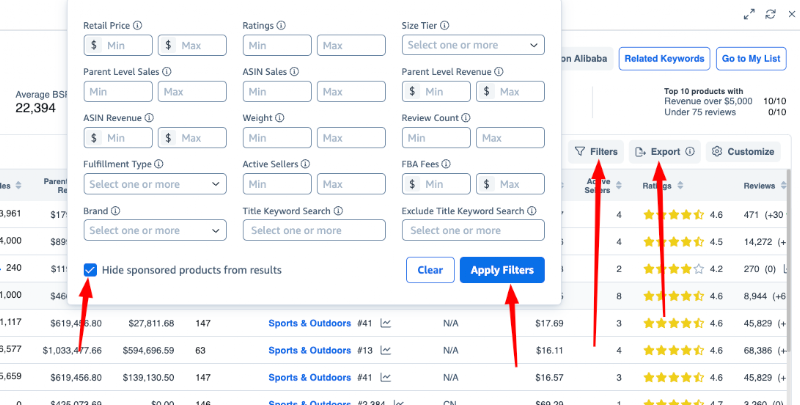
- Hide sponsored products and export the CSV
- Paste it into the X-ray paste tab
Sorted by parent revenue. EU/UK: make sure numbers use dots for decimals before pasting.
- Add the niche as a row in the Master chart
Copy the X-ray summary values into the blue columns.
- Fill in the manual (yellow) columns


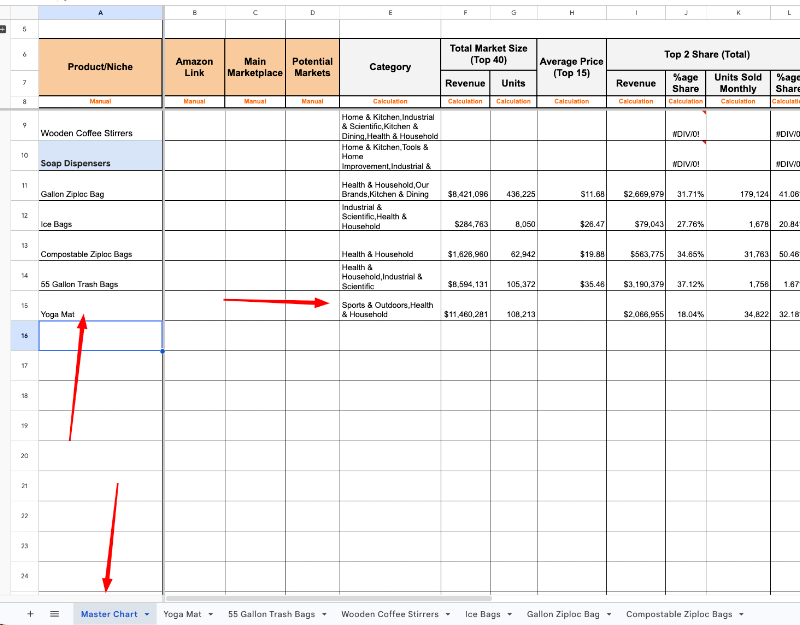
Each column's points reflect how important it is; the final score combines them. The higher the score, the better the chance. It's not set in stone: you'll still check trends, seasonality, problematic categories and more later.
Phase 2: find 50+ product ideas
Every method aims for the same thing: one product on Amazon that signals a high-potential market, with relatively high sales, few reviews and relevance to your brand. Find it, then: identify its main keyword (usually in the title), search it on Amazon, export the data with the extension, check in 1–2 minutes that it looks solid, and add it to the sheet.
| Filter | Setting |
|---|---|
| Category & subcategory | Only the ones that fit your brand |
| Review count | Min 50, max 200 (higher with more capital, lower for less competitive categories) |
| Fulfillment | FBA |
| Parent-level revenue | Min $25,000 (higher for bigger brands, lower for smaller markets) |
| Title keyword (optional) | One product-type word per search, e.g. "drops" for liquid vitamins, "paper" for paper products |
- Low reviews + good sales is the first signal. Since Q2 2026 reviews may not be merged on many products: make sure you're not looking at one variation of a listing with many reviews.
- Then take 1–2 minutes on the market: search the main keyword. Not VERY competitive? Add it.
- Rule: avoid markets with more than 4 listings over 5,000 reviews (they take the top 4 organic spots almost always). Many well-known brands is another sign of a very competitive niche.
| Method | How |
|---|---|
| 2. Frequently bought together + seller storefront | On each of your listings, check Frequently bought together: customers buy those with yours, a strong sign your buyers want them. Products with high cross-sell potential are strong candidates. Also open each of those sellers' storefronts for more ideas. |
| 3. Competitors' storefronts | Search your top products' main keywords, open the top listings and check each seller's storefront. Visit at least 10–15 competitor storefronts per best seller. |
| 4. Amazon New Releases | Go to New Releases in your relevant categories (e.g. Beauty & Personal Care) and look for low reviews with high sales. |
| 5. Your own knowledge | List every related product idea you have, search each main keyword, and add the ones that aren't too competitive. |
| 6. Brand-related outlier keywords | Sell yoga mats? Search "yoga" or "pilates" and go down the rabbit hole across many pages. Social media (TikTok, with tools like FastMoss or Kalodata) can spot trends before Amazon: risky, but very high reward with little competition. |
With 50+ ideas, fill in every manual column (show a trusted VA 2–3 niches, then let them do the rest): niche, Amazon link, marketplaces, expected price, landed COGS estimate, FBA fee, better value at 35%+ margin?, search volume (360 days) and growth (180 days), Amazon, FBM, Chinese, strong and different sellers in the top 10, differentiation, variations market, Subscribe & Save, reorder frequency, seasonality, brand fit (1–10), and the red flags: more than 5 Amazon listings in the top 10, existing patent, trendy in the last 4–8 months, problematic category.
Phase 3: narrow down to 15
With 50+ ideas, all manual columns filled and a final score for each, mark the 15 with the highest score (color column A, then sort by color). A good score is a high score relative to your own list: markets vary too much for an absolute number.

- You can still add a lower-scoring idea if you have another advantage: a very strong differentiator nobody offers, a way to source it very cheaply, or a way to cut weight and dimensions for lower FBA fees that nobody uses yet.
- If you can create a competitive advantage, do it: it's the most powerful thing you can do for an Amazon product.
Phase 4: narrow down to 7
Spend 60+ minutes on each of the 15 (15+ hours in total) to see which are as good as the surface data suggests. Copy them into the Narrow to 7 tab and work through each column.
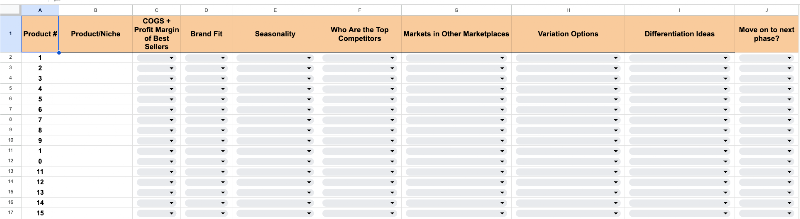
| Criterion | What to check | Good sign | Bad sign | Time |
|---|---|---|---|---|
| COGS + margin of the best sellers (highest impact) | Estimate the top 1–2 sellers' landed cost (Alibaba search prices) and margin: is there room for 35%+ at a competitive price? | Leaders seem to run healthy 35%+ margins | Leaders run thin margins; no room to compete on price | 5–10 min |
| Brand fit | Would your customers expect it in your store? Can you cross-sell it? | Natural fit, spillover traffic from your listings | Unrelated to your brand | 1 min |
| Seasonality | Demand over 12–24 months | Evergreen | Sharp seasonal spikes: harder stock and cash flow | 3–5 min |
| Top competitors | Open the top 5–10 and their storefronts: how many products, listing quality, big brands, Amazon 1P, Chinese or small FBA sellers? | Small or mid sellers with weak listings | Well-known brands, Amazon 1P or high-revenue Chinese sellers | 5–10 min |
| Other marketplaces | Demand on UK, DE, CA… | Sells well in several marketplaces | Little demand outside the US | 3–5 min |
| Variation options | Colors, sizes, styles, bundles among competitors | The market supports variations | Single-SKU item, little upsell | 2–3 min |
| Differentiation ideas | Better design, features, bonus item, packaging, bundle? | A clear, specific idea | Generic, hard to improve | 5–10 min |
Then remove the 8 weakest: drop the clear losers, keep the clear winners. It's fine to go on with more than 7, or with only 5 if the rest are clearly weak. Don't cut corners here.
Phase 5: finalize the top products
These 7 came through a data-driven process: you're unlikely to find better markets. Your job now is to make it work. For each: define the offer, then get real costs from suppliers.
| Approach | How | Example |
|---|---|---|
| Better value for money (recommended) | More than competitors at the same price: more quantity, bigger, better materials or a bonus item. Don't just sell cheaper; keep 35%+ margins. Lowest risk. | Everyone sells a 10-pack for $8.99–9.99 → you sell a 12-pack at $9.99 |
| Premium | Better materials or features at a higher price. Riskier: at 50–100% above the niche average, organic rank is much harder. | |
| Differentiated | A bonus item, design improvement, better packaging, smarter bundle or function, only if you keep 35%+ at a competitive price | Packaging that doubles as storage · selling to women where everyone targets men · a smaller package for lower FBA fees |
Any referral or FBA fee advantage can be a BIG edge. Ideas come from competitors' 1–3 star reviews (real pain points), AI assistants fed with competitor reviews, TikTok comments, Pinterest/Instagram design trends, and Etsy's creative angles.
- Contact 25–30 Alibaba suppliers per product
The exact product (Jungle Scout's supplier database shows where competitors source). Send the 2 best-rated competitor listings (ideally 4.5+) and ask for quotes on their offer and yours at several quantities: manufacturing cost, dimensions and weight, and estimated freight to FBA (supplier + forwarder).
- Calculate the real margin
Landed cost, FBA fee and referral fee at a competitive price.
- Keep the best 5–10 suppliers
Best price, communication and English. Brainstorm differentiation with them: they know what's possible. Don't order samples yet.
- Compare and pick 1–3–5 products
Highest gross margin, strongest differentiation (ideally solving a real pain point, for a higher CVR), best overall competitive position.
- Then: samples, PO and launch prep
Expect 2–3 rounds of sample feedback. Then the PO, market analysis, keyword research, listing and the launch plan.
Price, VAT, FBA fee, referral rate, product and freight cost, and an optional coupon to the gross profit margin, its band (36–42% ideal) and what to do.
Want these numbers for your own account? Get a free audit →Related guides
- New product research methods, market analysis and sourcingThe detailed R&D process: know your ideal customer, pre-analyze each niche (3+ sellers under 1,000 reviews, top sellers under 10,000), six…
- New product R&D checklistThe R&D process as a checklist: the method for all six research approaches, the initial filter, analyzing 15–30 opportunities down to…
- Researching and launching new variationsNew variations of a successful product rank faster with its shared reviews. Find variation ideas from competitors and keyword groups,…
- Launching a new productUse the 90-day honeymoon well: competitors and main keywords, title SEO, launch price, early reviews through Vine, a PPC budget from your…